What is your actual warm p95 / p99 to the endpoint your system depends on?
SOLANA EXECUTION LATENCY INTELLIGENCE
Measured evidence ↓2026 INFRASTRUCTURE DECISION BRIEF
Your code may be fast.Your route may not be.
A logically correct Solana stack can still lose time in the path between your host and the infrastructure you depend on. This preview shows the measured boundary before the paid report shows the full diagnostic model.
SELF-AUDIT / BEFORE YOU OPTIMIZE
CAN YOU ANSWER THESE WITHOUT GUESSING?
Which ASN and route does your host actually take to that endpoint?
Does your telemetry distinguish:
ACK → LANDED → CONFIRMED → VERIFIED?“If any answer is ‘I think so,’ that layer is not measured yet.”
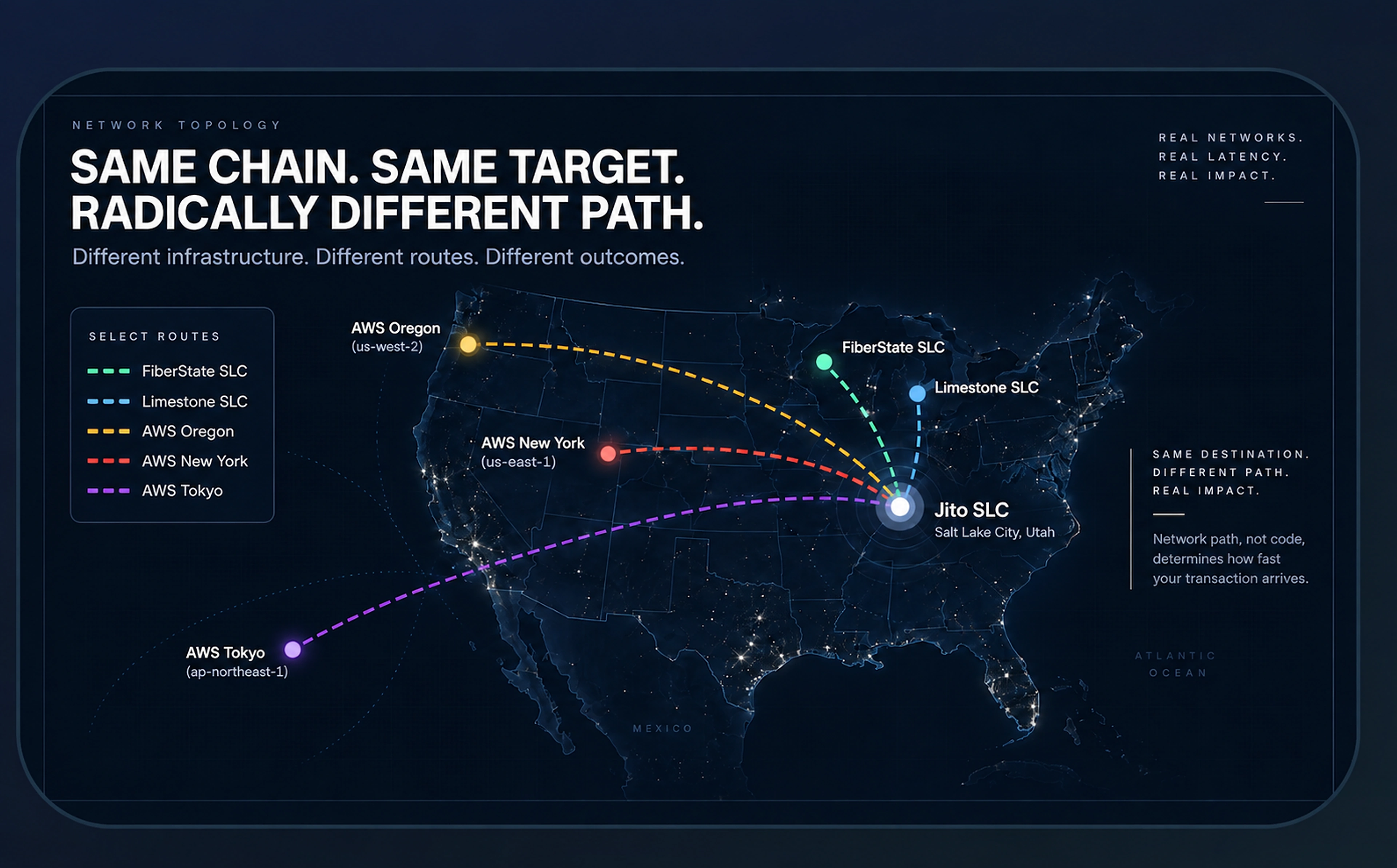
FiberState SLC public probe~1 msobserved TCP path
AWS Oregon → Jito SLC34.617 mswarm p50 request
Cold first request110.480 mssame Oregon baseline
SCROLL TO INSPECT THE PATH
01 / TOPOLOGICAL CONTRAST
What the route actually changes.
Geography narrows the search space. Topology determines the actual path. The numbers below describe different timing boundaries; they are not a single end-to-end execution benchmark.

MEASURED — FIRST PARTY20 / 20
successful warm Oregon requests
MEASURED — PUBLIC PROBE0.570–0.656 ms
FiberState final traceroute observation
INTERPRETATION BOUNDARYTransport ≠ landing
request timing is not on-chain execution timing
DECISION SYSTEM / NOT JUST DATA
THE NUMBERS ARE NOT THE PRODUCT.
A benchmark tells you what happened in one measured window.
A decision system tells you what to measure next, what boundary changed, and whether the migration actually improved the system.
OBSERVE↓CLASSIFY↓FORM A BOTTLENECK HYPOTHESIS↓CHANGE ONE LAYER↓RE-MEASURE↓ACCEPT / REJECT
“The product is not the historical number. The product is the loop.”
02 / ASSUMPTION BREAKS
Three rules that survive contact with the wire.
Same city ≠ same topology.
A metro label does not describe peering, transit, destination resolution, or the exact route your host takes.
ACK ≠ landed ≠ verified.
Acceptance by an upstream service is a different evidence state from block inclusion, commitment, and verified state change.
Cold ≠ steady state.
DNS, TCP, TLS, reconnects and provider work must be separated before calling a deployment “fast.”

03 / EXECUTION EVIDENCE
The dangerous word is “success.”
A request can be built, submitted, acknowledged and still fail to become the state transition you intended. The paid brief treats each boundary as a separate evidence contract.

“An acknowledgement proves acceptance, not execution.”
04 / ZERO-SCAM ANCHOR
No coin tips. No profit claims. No fake private telemetry.
This is an engineering intelligence product: measured paths, provider facts, provider-reported benchmarks, interpretation boundaries and a reproducible benchmark framework.
Unresolved provenance remains unresolved. Public probes are not presented as dedicated-host guarantees. Transport latency is not presented as transaction landing latency.
This report will tell you when its own evidence is insufficient.PROVISIONAL
Google SLC remains provisional.
BOUNDARY
A public probe is not a dedicated-host benchmark.
BOUNDARY
Transport timing is not transaction landing.
AI-ERA DIFFERENTIATION
AI CAN EXPLAIN THE STACK.
IT CANNOT CREATE THE MEASUREMENT YOU NEVER COLLECTED.
Generic AI can explain Jito, Yellowstone, TCP, TLS, ACK semantics and Rust networking.
But explanation is not observation.GENERIC AI
explains architecture
→THIS BRIEFpreserves observed measurements and provenance
GENERIC AI
suggests possible bottlenecks
→THIS BRIEFprovides a framework for proving which boundary changed
GENERIC AI
generates code
→THIS BRIEFtells you what evidence is required before calling a migration better
Knowledge is abundant. Comparable evidence is not.
05 / LOCKED INSIDE THE FULL BRIEF
What the preview deliberately stops before.
You have seen the observations. The paid brief contains the decision framework that determines what they do — and do not — justify.
01
Full evidence register and provenance boundaries
02
FiberState / GraniteIX / TeraSwitch route context
03
Cold vs warm measurement interpretation
04
ACK → landed → confirmed → verified state model
05
Deployment decision matrix and migration acceptance gate
06
Reproducible benchmark framework
07
Operator migration checklist
08
Evidence appendix
OPERATOR EDITION
BUILT FOR OPERATORS. NOT SIGNAL BUYERS.
- Solana execution-system developers
- latency-sensitive operators
- Jito / RPC / Yellowstone users
- infrastructure engineers
- technical founders measuring deployment performance
- coin-call buyers
- beginner trading education
- guaranteed-profit seekers
- signal groups
- users looking for a copy-paste trading strategy
06 / ACCESS LAYER
Stop optimizing the layer you never measured.
You are not paying $249 to learn what Jito is.
You are paying for a disciplined way to determine which layer deserves your next engineering hour.
ONE-TIME ACCESS$249 USD
Stripe checkoutImmediate digital delivery after verified paymentNo recurring fee
Already purchased? Access your operator brief →No profit guarantee. No same-slot guarantee. No first-block guarantee. Independent technical research. No affiliation or endorsement implied.